
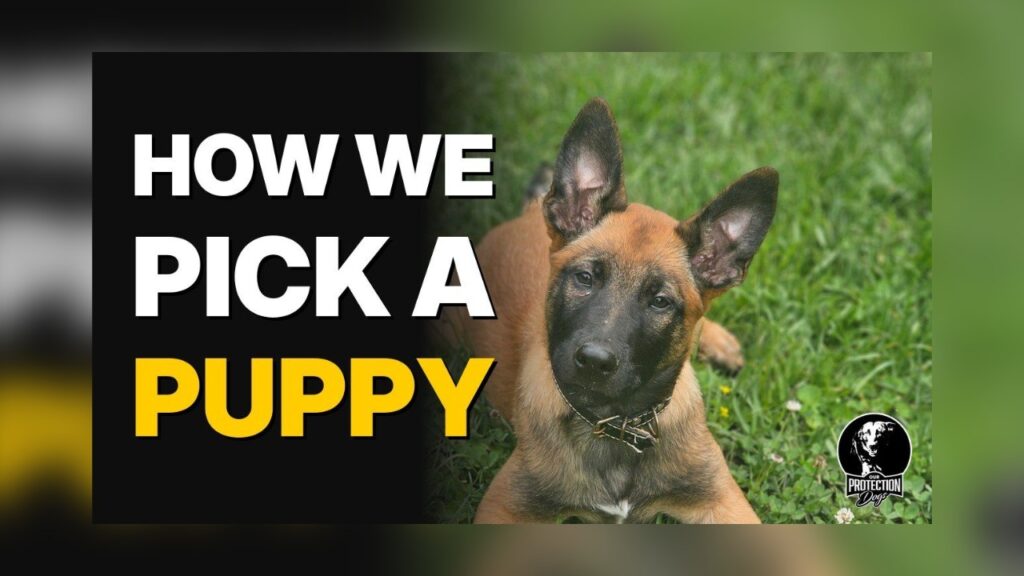
Most people choose the wrong protection puppy for one reason: they choose with their heart. Buying a puppy is an emotional moment, and emotion is exactly what hides the things you need to see.
When we select a puppy for ourselves, we set the feelings aside and look at each pup as an individual. These are the things we test for, and the puppies we walk away from, even when everyone else in the room loves them.
Prefer to watch? This post is based on our video: How we choose a protection puppy.
Don’t take the first puppy that runs to you
“He chose me” is the most common mistake we hear. We almost never take the first puppy that comes to us.
The first one over is usually the attention seeker. It wants backup. It needs you. For a pet, that is a lovely way to choose. For a protection dog, it is the wrong trait to start with.
A protection dog must be able to deal with a human threat without leaning on you. That independence is not something you add later. You pick it, or you miss it, on the day you choose the puppy.
The growler is not the brave one
People love the growler, and plenty of breeders will point to it as the “aggressive one” with a future. It is the last puppy in the litter we want.
Growling is not protection and it is not fighting. It is fear. The growler is saying, “Stay away from me, I’m reaching my limit.” Think of the man who keeps telling you he is going to beat you up and never does. All that noise is there to keep things at a distance.
A puppy that is already in that much conflict at eight weeks is not showing you courage.
Test the puppy alone, somewhere it has never been
Testing a puppy where it lives every day, surrounded by its siblings, tells you very little. That is its comfort zone.
Take the puppy somewhere new, even if that only means from the kennel into the house, and test it there on its own. For most pups this is the first time they have been away from the litter in a place they don’t know. Now you see who the puppy really is.
Everything below happens in that neutral space, one puppy at a time.
Watch the recovery, not the fright
We pop open an umbrella near the puppy, and we drop a ball on the floor to check for noise sensitivity. We have yet to meet a puppy that doesn’t get a fright. So would we.
The fright is not the test. What happens next is.
- What we want: the puppy startles, then turns around and goes to investigate. It creeps closer, sniffs the thing and gets over it.
- What we don’t want: the puppy runs and does not come back, or keeps avoiding the object.
That difference in recovery is the difference in character between two puppies.
Prey drive: we don’t want the natural retriever
To check prey drive we throw something small that moves, usually a crumpled piece of paper, and see whether the puppy reacts, chases it and picks it up. Some trainers in Holland test with copper pipes and other odd objects. You don’t need to go that far.
This is where we disagree with a lot of sellers. If we were choosing a German Shorthaired Pointer as a bird dog, a puppy that brings the paper straight back would be ideal. For a Belgian Malinois or any protection prospect, it is not.
We have watched a breeder throw a ball for a tiny female, see her bring it straight back, and call her fantastic. For protection work, the fantastic one picks the thing up, runs off with it and won’t let you have it. It’s hers now.
The strongest puppies take this further:
- The littermates won’t even challenge them for the item. They walk circles around the pup and keep their distance.
- On the flirt pole, the rest of the litter stops playing once that one joins in.
That is the puppy we want.
The Malinois and German Shepherds you see bringing a toy back and letting go were trained to do it. We spend a lot of time on engagement games to build that. A puppy that naturally hands things over is playing a hunting game, not a fighting game, and it will hand the sleeve to the decoy just as easily.
Independence: the puppy that goes exploring
When we put a puppy down in the new space, we like to see it start investigating straight away. That is confidence.
If the pup is more interested in what is going on over there than in us calling and running backwards, we are happy. Recall can be trained. That part is not a problem.
What can’t be trained in is the independence itself. When we want a dog to work 30 or 40 metres away from us, we need one that doesn’t need its hand held the whole time.
The flirt pole: the most important test
We bring our own flirt pole, so we know the puppy has never seen it before. Then we watch two things.
The chase. When the puppy sees the movement, is it on it immediately? Or is it too worried about the new environment to chase at all?
The grip. Once the puppy has it, does it hold on and try to take it away? We use a piece of leather and play two or three rounds, pulling it out of the puppy’s mouth each time. If we can still pull it out on the third try, that puppy can go. If it has clamped down by then and we can’t get it back, that’s our pup.
You can see the attitude in the body. The tail goes up and stiffens, the front feet come over the leather and the dew claws dig in.
One last check: pick the puppy up while it is holding on. A lot of pups let go the moment their feet leave the ground. The one that is still gripping while you lift and pull is the one coming home with us.
Be careful of the needy puppy
Some puppies, once they are in the new environment, want only one thing: your attention. They are very busy, they moan and they jump up on you. It looks like affection. It is stress. The puppy is uncomfortable and is asking you to fix it.
That neediness does not go away with age. Yes, you can teach these dogs to bite, and they will go and do it. But you see the question on their face every time: “Must I go now? Is this what you want?”
We would far rather have to put the brakes on a dog than tell it two or three times that it is allowed to bite. Needy dogs can cope at the entry levels of a sport. They rarely make it to the upper levels, because at four years old they still need you to guide them through every step.
The short version
| We want the puppy that | We walk away from the puppy that |
|---|---|
| Goes off to investigate a new place | Runs to us first and clings |
| Gets a fright, then goes back to sniff | Runs away and stays away |
| Grabs the item and keeps it | Brings it straight back and hands it over |
| Clamps down harder each time we pull | Lets go when pulled or picked up |
| Is quiet and sure of itself | Growls, moans or jumps up for help |
Choosing the right puppy is only the start, and choosing the right breeder comes before it. Our e-book, Raising Your Personal Protection Dog, covers the whole process from selecting a breeder to picking your puppy.
If you look for something different when you choose a protection puppy, or you disagree with anything here, ask us. We are happy to explain our method and where we learned it.