
Nov 19, 2026 · @Marilé
The first year of a protection puppy’s life decides what kind of adult dog you end up living with. Most of the problems we’re asked to fix in older dogs, like biting family members, leash grabbing, reactivity and poor bite work, started with small habits in puppyhood that seemed harmless at the time.
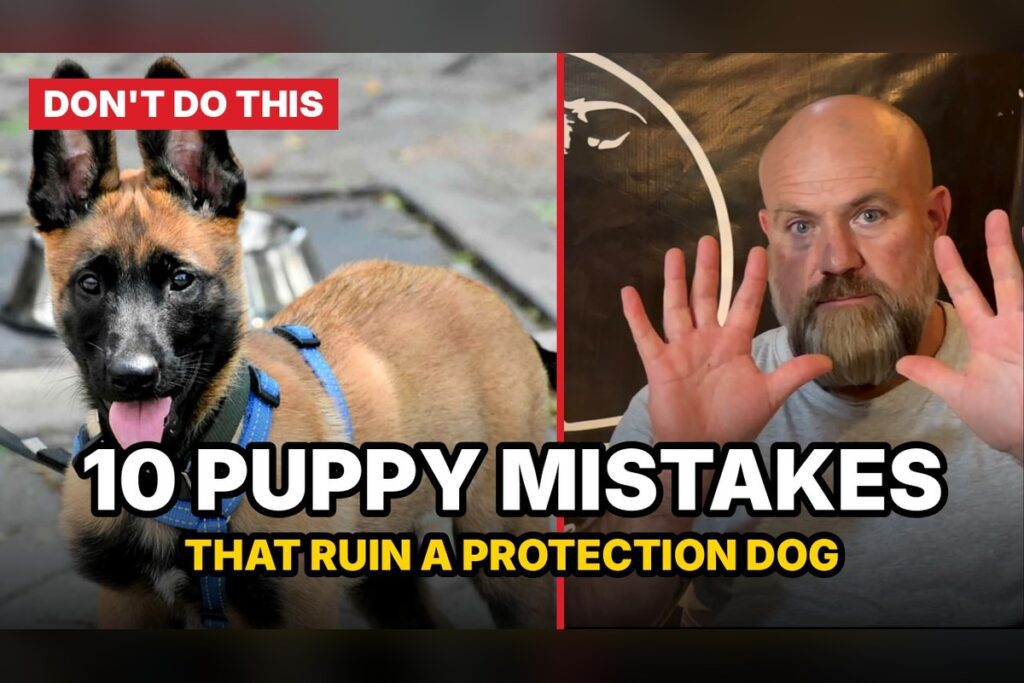
We’ve raised, trained and placed working dogs for years, and these are the ten things we will never do with a protection puppy. A protection dog should be a companion first: calm and easy to live with at home, switched on when it matters. Everything below serves that goal.
Prefer to watch? See the full video on YouTube.
In short, we never:
- Let the puppy bite us, our kids or family during play
- Let the puppy bite or hang on the leash
- Push advanced obedience (long stays, call-offs) on a baby puppy
- Let an inexperienced helper do bite work with our puppy
- Wait until a year old to start training
- Use a self-feeder
- Leave the puppy unattended with older dogs
- Let the dog ride loose on the back of an open bakkie
- Skip crate training
- Laugh off barking and lunging at people and dogs on the leash
1. Let the puppy bite us during play
We never play rough with a puppy and let it bite our hands, arms or clothes. We hear the same misconception all the time: “It’s a protection dog, it has to bite a person one day, so I can’t correct it for biting me.” That thinking causes real problems.
A puppy that comes home at 8 weeks is still in its imprinting phase. If it learns that biting you is fine, it is learning that biting your kids and your partner is fine too. That lesson sticks.
A protection puppy gets all the biting it needs in two or three short, structured sessions a day, on a flirt pole, a puppy tug or a puppy sleeve. Outside those sessions, if the puppy wants to bite, give it a toy instead of your hand.
Remember: playing is learning. When two puppies play, they aren’t only burning energy. They’re testing who’s stronger and practising going for the neck and legs. Your puppy learns from every game you play with it too. If you run structured bite sessions and then wrestle with it on the floor, you’re only confusing it. Be deliberate about what each game teaches.
2. Let the puppy bite the leash
Leash biting escalates fast, and some puppies become obsessed with it, Malinois especially. We’ve seen year-old dogs still hanging off frayed, chewed-up leashes. Correct it while the puppy is small and you’ll never have to fix it in a strong adolescent.
3. Push advanced obedience on a baby puppy
We don’t teach long stays to a puppy of 9 to 14 weeks. Getting a young puppy to hold a stay takes a lot of corrections, and that much pressure is bad for a baby dog. Watch competition-style stays closely and you’ll often see the dog lick its lips or turn its head away as the handler approaches. Those are calming signals, a sign of stress.
Think of a child who loves the piano but gets rapped on the fingers at every lesson. Within a month they quit. We want a puppy that loves training, so we build motivation first. Sits and downs are taught with food lures, and the puppy works for its food. Stays and duration come later. There’s plenty of time.
The same goes for call-offs. People send us videos of puppies under 10 weeks being sent at a person and then called back before the bite. That puppy can’t even bite properly yet. Teach the dog to bite well first. Only then teach it to come off a bite.
4. Let an inexperienced helper work our puppy
We would never hand our protection puppy to a helper or decoy who doesn’t know what they’re doing. That includes a friend or the gardener who’s keen to help. Someone who can’t read a puppy can teach it bad habits in a few minutes, and some of that damage can’t be undone.
Good puppy work on a flirt pole looks like two people who know how to dance: one moves forward, the other moves back, and it flows. Timing is everything. A puppy doesn’t understand “good boy” in the moment. It understands what happened the instant it did something right, which is why we use markers. That reward window is a split second. Miss it and the rep means nothing to the puppy.
We keep these sessions to about three minutes, and every rep has to mean something. The puppy is in its imprinting phase, and mistakes made now stay.
5. Wait until a year old to start training
Some people still believe you shouldn’t train a protection dog before 12 months. It’s usually advice passed down from old-school police trainers. Back then, protection training was harsh enough that young dogs genuinely couldn’t handle it.
Training has changed, and young brains learn fastest. A child picks up a new language in months that an adult struggles with for years. Puppies are the same. What you teach between 6 and 12 weeks, and through the first year, is the foundation for everything after. Bend the tree while it’s young.
Start right and you can have a fully trained dog at three or four years old. Waiting a year wastes the best learning window your dog will ever have.
6. Use a self-feeder
A dog with food in front of it all day doesn’t need you, so why would it work for you? Self-feeders also let puppies overeat, which is unhealthy and, in deep-chested breeds like the Malinois, a risk factor for bloat.
We feed our puppies three small meals a day, which also keeps their blood sugar steady. That’s three training opportunities every day. Our puppies rarely eat from a bowl: they earn their meals from our hands.
7. Leave the puppy unattended with older dogs
We never leave a puppy or young dog alone in the yard with our adult dogs. It only takes one trigger, like a strange dog running the fence line, for redirected aggression to turn on the youngest dog in the group.
Our puppies only socialise with adult dogs when we are there to supervise. Not our kids, not a caretaker, not a handler. Us.
8. Let the dog ride loose on the back of an open bakkie
In southern Africa we see it every day, and every day it worries us. Dogs fall off, or jump off.
Years ago, one of us took a pair of pointers out bird hunting, loose on the back of the bakkie. At a busy traffic light next to a smallholding, he looked up to see his dog standing in the middle of the road, pointing the geese. She was fine, by sheer luck.
Now our dogs travel in a crate, and the crate is strapped down so it can’t slide. We never tie a dog on the back of a vehicle either. If it jumps, the leash becomes a noose.
9. Skip crate training
Crate training is one of the most important things you can teach a puppy, and it isn’t cruel. Dogs learn to love their crate. Our crates are inside the house, with the family.
It’s also the best management tool you’ll have. Picture a birthday party: kids running, screaming, jumping on the trampoline and into the pool, and a six-month-old Malinois in bite-work training loose in the middle of it. A crate prevents that disaster, along with the vet bills and the angry parents. It’s just as useful when a dog is injured, sick or needs to rest.
10. Laugh off barking and lunging on the leash
A young puppy barks at a passing person or dog, and the owner thinks it’s cute, or proud that the puppy is “already protective.” That puppy is on its way to becoming the dog you can’t take anywhere.
Reactivity is one of the most searched dog problems online, and this is where it starts. Usually the puppy isn’t protective at all: it’s insecure, and it’s trying to look big to keep the other dog or person out of its space. If you laugh or reward it, it learns to keep doing it.
It isn’t funny when it’s a 35 kg Malinois male lunging at a woman walking past with her little poodle. Don’t let it start. What you want from a protection dog in public is neutrality towards people and other dogs.
Bonus: the one thing we always do
We feed a good-quality puppy food made for large-breed or working-breed puppies, and we keep the dog on it until about two years of age before switching to adult food. Many people switch at one year, which we think is too early.
We don’t add extra calcium or supplements. A good-quality large-breed puppy food already has what a growing puppy needs.
Frequently asked questions
Should I let my protection puppy bite me? No. Biting belongs in short, structured sessions on a toy, tug or puppy sleeve. A puppy allowed to bite family members during play learns that biting people at home is acceptable.
At what age should protection dog training start? Foundation work starts as soon as the puppy comes home, usually at around 8 weeks. Early sessions are short and play-based, and focus on motivation, food drive, biting a toy correctly and basic obedience with lures.
Should a protection puppy learn stays and call-offs? Not as a baby. Long stays need too much pressure for a young puppy, and a call-off only makes sense once the dog can bite properly. Both come later.
Is crate training cruel? No. A crate inside the house becomes the dog’s safe space, and it is the simplest way to manage a young working dog around children, visitors, injury or illness.
My puppy barks at people and dogs. Is that protectiveness? Usually it’s insecurity rather than protection. Don’t reward or laugh at it. Teach the puppy to stay neutral towards people and dogs in public.
Raise the dog you want to live with
None of these rules are about making a puppy hard. They’re about raising a protection dog that’s safe with your family, easy to take anywhere and clear in its work when it counts.
If you’re raising your own working-breed puppy and want help getting the foundation right, we offer one-on-one online coaching. If you’d rather start with a dog that’s already been raised this way, get in touch and tell us about your family.
Want the full roadmap for your puppy’s first year? Our e-book, Raising Your Personal Protection Dog, walks you through it step by step.